
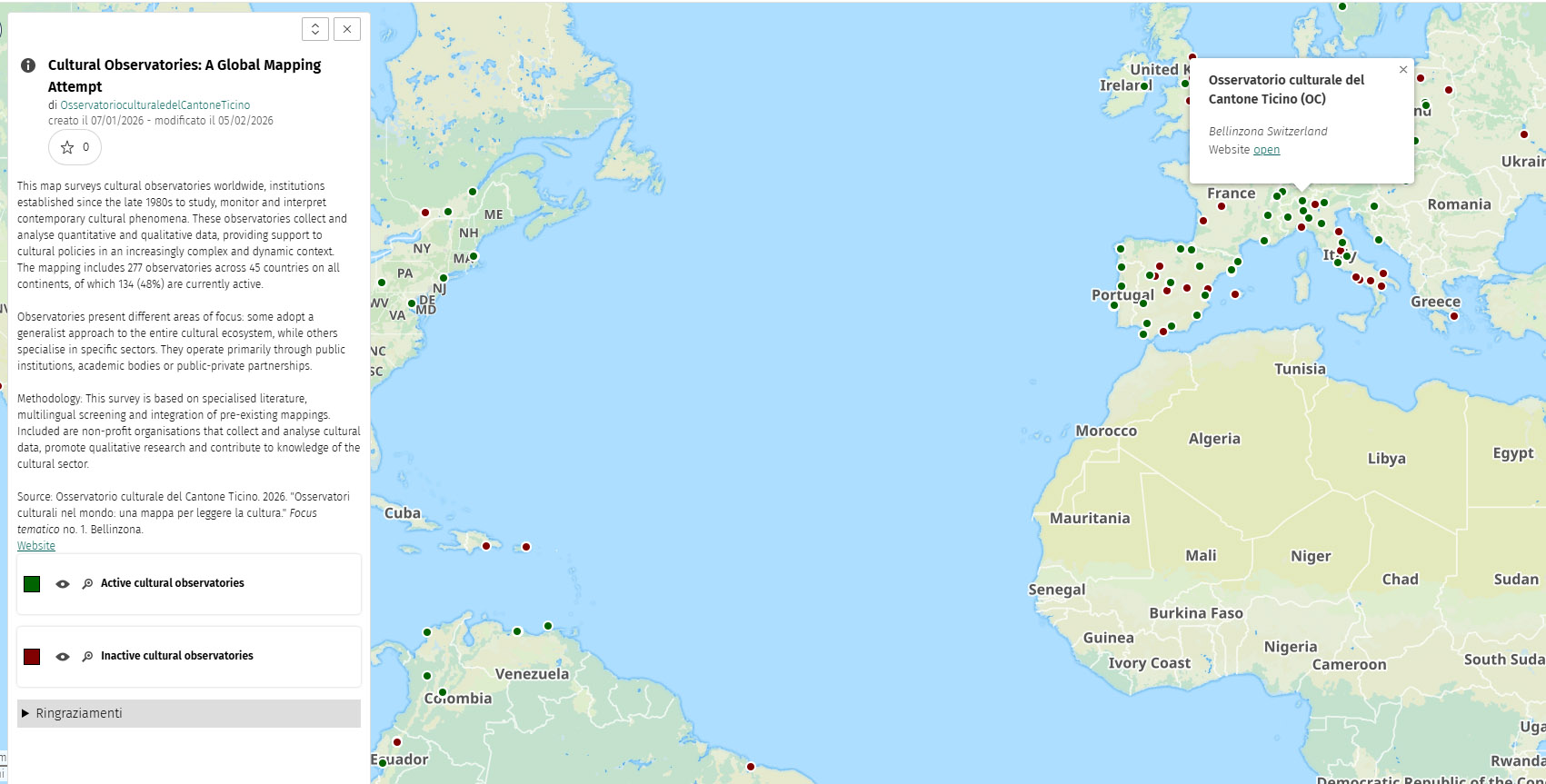
The publication “Cultural Observatories Worldwide: A Map for Reading Culture” (Thematic Focus no. 2 - 2026) presents an international survey of cultural observatories, with the aim of providing an overview of these institutions and their main characteristics.
The contribution stems from the need to address recurring questions regarding the distribution, nature and functioning of cultural observatories, in the absence of an international registry or federation that systematically records them. After a brief historical overview - tracing the emergence of observatories to the 1980s and identifying several pioneering institutions in Europe - the text analyses the evolution of the model, increasingly characterised by a multidimensional approach to the study of cultural phenomena.
The publication highlights the organisational diversity of these entities, which are predominantly linked to public administrations or academic institutions, and in some cases operate through partnerships with private or third-sector actors. Their fields of investigation range from general approaches covering the entire cultural system to thematic specialisations (visual arts, performing arts, cultural heritage, creative industries), using methodologies that integrate both quantitative and qualitative analysis.
The central chapter is devoted to the mapping conducted by the Cultural Observatory of the Canton of Ticino at the beginning of 2026: observatories were identified in 45 countries across all continents; of these, 134 are currently active, while for 143 no recent activity could be verified. The highest concentration is found in Europe and South America, with Spain, Italy and Brazil among the most represented countries. The map is available online, and the data are released under a Creative Commons 0 (CC0) licence, in line with principles of openness and collaborative updating. The text concludes by outlining the methodological criteria adopted for the inclusion and exclusion of organisations, underlining the margins of subjectivity in defining the scope and the dynamic nature of the phenomenon.
To consult the map and edit its data: http://u.osmfr.org/m/1340668/
Full text (in Italian): https://www4.ti.ch/decs/dcsu/uapcd/pubblicazioni/osservatori-culturali-nel-mondo-una-mappa-per-leggere-la-cultura
Hochstrasser, Roland. "Osservatori culturali nel mondo: una mappa per leggere la cultura". Focus tematico (Bellinzona), fasc. 2 (2026).