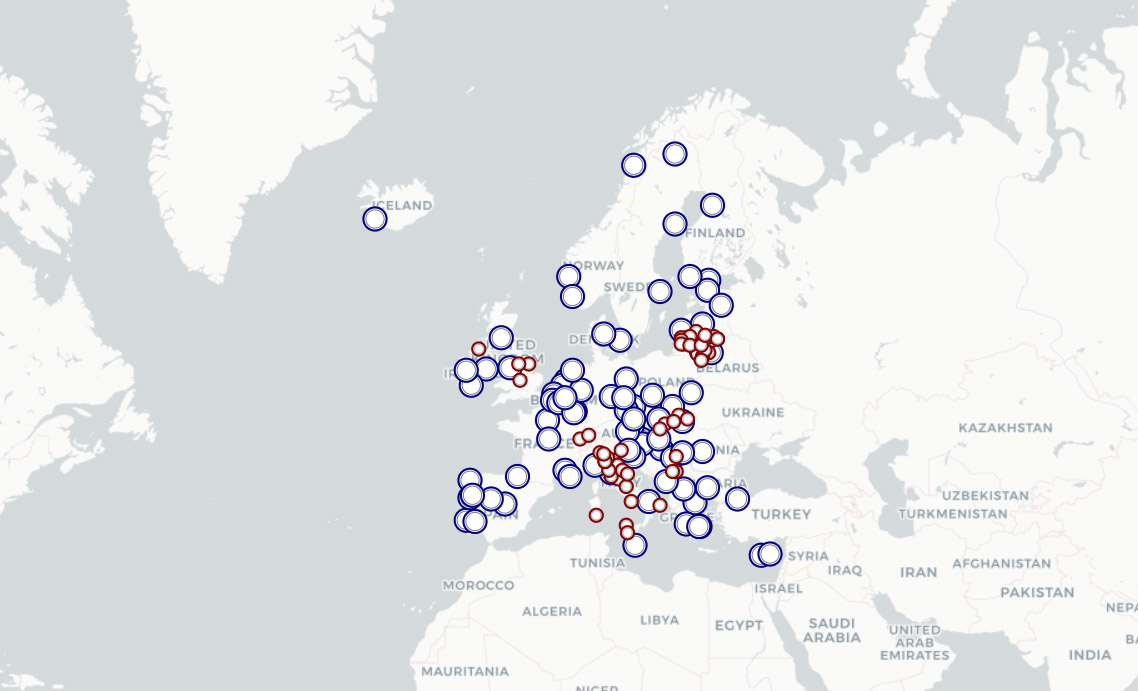
Each year, one European city -occasionally more- earns the right to call itself a capital: not of a country, but of culture itself. For twelve months, a title, a budget, and a spotlight land on a place, before moving on to the next one, leaving behind lasting impacts on local and regional cultural sectors. This map traces that pattern, starting with the very first title awarded in 1985 (Athens).
The European Capital of Culture (ECoC) is awarded annually to one or more cities across member states and, since 2017, occasionally to a city from Norway, Iceland, Liechtenstein, or an EU candidate country. What began as an invitation extended mainly to major national capitals -Athens, Paris, Madrid, Berlin- evolved, from the early 2000s, into an open competition that increasingly rewards small and mid-sized cities: places like Matera, Nova Gorica, or Bad Ischl now compete on equal footing with cities many times their size, and just as briefly hold the same title Paris once did. The map traces 85 ECoC designations spanning 1985 to 2030.
But Europe's cultural capitals landscape doesn't end with the ECoC. Around this EU-run title, a constellation of independent national programmes has grown, each with its own name, rhythm, and selection body, but the same underlying logic of a city holding the spotlight for a year before passing it on. Italy's Capitale Italiana della Cultura, the UK's City of Culture, Lithuania's Lietuvos kultūros sostinė, Slovakia's Mesto kultúry, Serbia's Nacionalna prestonica kulture, Poland's Polska Stolica Kultury, and -since 2027- Switzerland's privately-run Capitale Culturale Svizzera all stage the same rotation at national scale. Some of these titles are recent; others, like Portugal's or Belarus's, have already opened and closed, a reminder that the model can be as fragile as it is popular.
The same premise -a city, a year, a spotlight- has since travelled well beyond Europe: the American Capital of Culture has rotated mostly among Latin American cities since 2000, and the Arab Capital of Culture since 1996 under the Arab League and UNESCO. These are just a few examples among the many proposals still running or already relegated to history: the map holds 22 programmes and 374 designations in total: a deliberately open-ended perimeter, one where local and regional initiatives could just as easily be added. Their existence suggests that the idea travels well: a rotating spotlight, a year-long mandate, a city reinventing itself in public. A formula any city, on any continent, can make its own - proof that culture remains a universal tool for dialogue and mediation.
To consult the map: http://u.osmfr.org/m/1438788/
Sources
- «African Capitals of Culture (ACC)». https://www.uclga.org/africans-capital-cities-of-culture/.
- «American Capital of Culture». https://www.cac-acc.org/.
- «Arab Capital of Culture». https://www.alecso.org/nsite/en/mn-culture-2/projects-and-programs/capitals-of-arab-culture.
- «Capitais da Cultura - Cultura da Comunidade dos Países de Língua Portuguesa (CPLP)». https://capitalcultura.cplp.org/organizacao.
- «Capitale culturale della Comunità degli Stati Indipendenti (CSI)». https://e-cis.info/news/564/121742/.
- «Capitale française de la culture». https://www.culture.gouv.fr/aides-demarches/protections-labels-et-appellations/label-capitale-francaise-de-la-culture.
- «Capitale italiana della cultura - Ministero della Cultura». https://capitalidellacultura.cultura.gov.it/.
- «Capitale mediterranea della cultura e del dialogo». https://medculturecapital.com.
- «Capitals de la Cultura Catalana». https://www.ccc.cat/.
- «Cultural Capital of Asia - Asian Mayors Forum (AMF)». https://www.mayors.asia.
- «Culture and Arts Capital of the Turkic World». http://www.turksoy.org.
- «Culture City of East Asia». https://www.bunka.go.jp/english/policy/international/eastasia/.
- «Finno-Ugric Capitals of Culture». https://capitals.uralic.org.
- «Lietuvos kultūros sostinė». https://lrkm.lrv.lt/en/.
- «Mesto kultúry». https://www.fpu.sk/sk/.
- «Polish Capital of Culture». https://ifacca.org/news/2026/01/14/bielsko-biala-first-polish-capital-culture/.
- «Prestonica kulture Srbije». https://www.kultura.gov.rs/.
- «UK City of Culture». https://www.gov.uk/society-and-culture/city-of-culture.
- Associazione Capitale Culturale Svizzera (ACCS). «Capitale Culturale Svizzera». https://capitaleculturalesvizzera.ch.
- Green, Steve. «Capitals of Culture. An introductory survey of a worldwide activity». 2017. http://www.prasino.eu.