
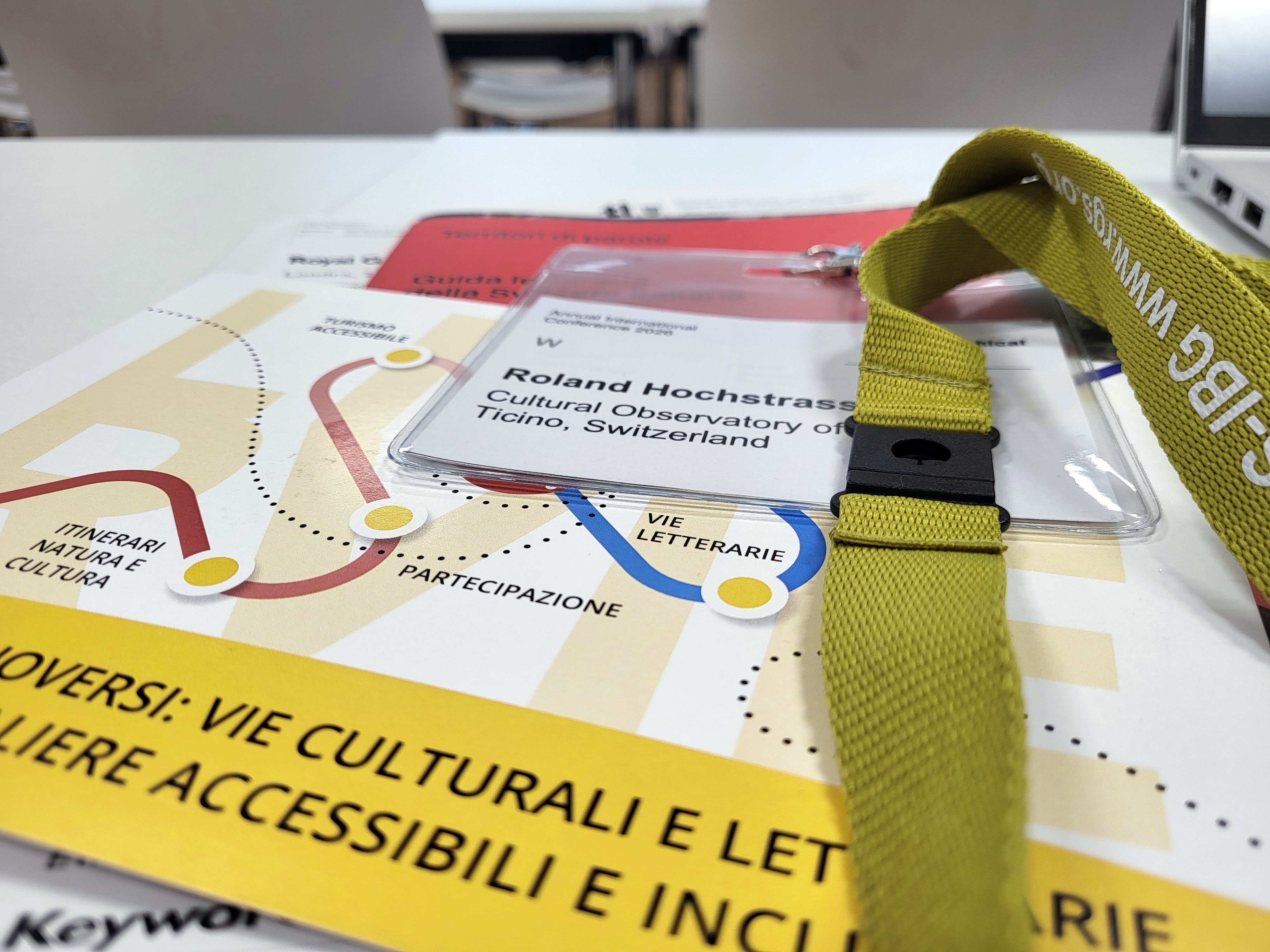
Cultural heritage, when made accessible and participatory, can constitute a powerful tool for countering spatial inequalities and injustices. As emphasised by the Faro Convention (Council of Europe, 2005), heritage is not a neutral object to be preserved, but a right to be actively exercised, capable of generating social cohesion and catalysing democratic processes.
Even in this sector, differential access to cultural spaces, itineraries and territorial representations still presents numerous critical issues (physical, digital or symbolic barriers), particularly for people with physical or mental disabilities, older people and marginalised communities. Cultural geography plays an important role in detecting these forms of injustice and in proposing operational solutions that can demonstrate concrete social impact on the territory.
The experience of the Literary Guide of Italian-speaking Switzerland (GLSI), developed by the Cultural Observatory of Canton Ticino since 2019, demonstrates how intangible heritage can be reactivated through digital and participatory strategies. The project has mapped over 3,500 literary quotations, 355 places and 800 deceased authors that describe the territory, transforming a resource that is often sedimented and forgotten into a shared and accessible cultural experience through open data, WMS maps, publications and educational activities. The project has adopted a practical and participatory approach, combining different techniques: documentary analysis conducted with the involvement of cultural operators and institutions; a survey addressed to local authorities to identify places of literary interest; editorial verification processes and integration of data into a literary map. In a linguistic minority context such as Italian-speaking Switzerland, this perspective takes on particular relevance and simultaneously shows how cultural observatories can evolve from passive actors to dynamic platforms for participation.
The LIBERVIE project (Interreg VI-A Italy-Switzerland 2021-2027) extends this experience by introducing the dimension of physical and digital accessibility as a central issue for analysing territorial inequalities. LIBERVIE operates in the regions of Verbano-Cusio-Ossola and Ticino and involves academic institutions, public administrations, museums and tourism organisations. The partners constitute an interdisciplinary laboratory that addresses the co-design of cultural itineraries that integrate literary components, architectural, sensory and cognitive barriers. The participation of people with motor, sensory and intellectual disabilities runs through all phases: workshops, focus groups and field verifications bring to light critical issues ignored by conventional planning. Among LIBERVIE's missions, the dissemination of open data has been maintained, furthermore extending the scope to open source working tools (Wikimedia platforms, OpenStreetMap, uMap).
The extension of the reference area to a cross-border region highlights how ephemeral borders are at a cultural level: the mapping of literary heritage indicates continuity and interaction between regions, in antithesis to political visions that invoke absolute values represented by frontiers.
Roland Hochstrasser
RGS-IBG Annual International Conference, Royal Geographical Society and Imperial College London, London, 1-4 September 2026
https://www.rgs.org/research/annual-international-conference
* LIBERtà di muoversi: VIE culturali e letterarie transfrontaliere accessibili e inclusive: Università degli Studi del Piemonte Orientale “Amedeo Avogadro” - Dipartimento di Studi per l'Economia e l'Impresa - DISEI (Novara); Repubblica e Cantone Ticino - Ufficio dell’analisi e del patrimonio culturale digitale - Dipartimento dell'educazione, della cultura e dello sport (DECS)/ Divisione della cultura e degli studi universitari (DCSU); Distretto Turistico dei Laghi Scrl (Verbano-Cusio-Ossola); Provincia del Verbano-Cusio-Ossola; Unione Lago Maggiore (Verbano-Cusio-Ossola)